
- Commercial banks providing more money to the coal industry since the Paris Agreement
- Japanese banks are top lenders, while China, Japan and India account for 70% of underwriting to coal companies
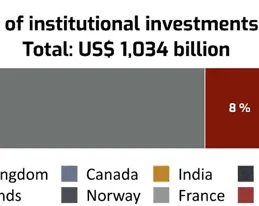
- US investors hold 58% of institutional investments in the coal industry, with Japan in second place
Global — Today, Urgewald and a group of more than 25 civil society organizations, including Reclaim Finance, Rainforest Action Network, and 350.org, published groundbreaking research on the financiers and investors behind the global coal industry.
The Global Coal Exit List (GCEL) shows that, by January 2021, 4,478 institutional investors held investments totaling US$ 1.03 trillion in companies operating along the thermal coal value chain world wide. Among the investors covered by the research are pension funds, mutual funds, asset managers, insurance companies, commercial banks, sovereign wealth funds and other types of institutional investors.
“In past years, the scope of our financial research was limited to around 200 coal plant developers. Our new research, however, analyzes financial flows to all 934 companies on the Global Coal Exit List (GCEL). This is the first time anyone has attempted to analyze commercial banks’ and institutional investors’ exposure to the entire coal industry,” says Katrin Ganswindt, head of financial research at Urgewald.
Top Institutional Investors in the Coal Industry
The world’s largest institutional investor in the coal industry is the US mutual fund company Vanguard, with holdings of almost US$ 86 billion. It is closely followed by BlackRock, which holds investments of over US$ 84 billion. Together, these two investment giants account for 17% of institutional investments in the global coal industry.
Based on their size, BlackRock and Vanguard’s coal investments are in a class of their own, but they are also representative of a much bigger problem. US investors are the single largest provider of institutional investment to companies on the Global Coal Exit List. With shares and bonds in value of US$ 604 billion, US investors collectively account for 59% of institutional investments in the global coal industry.
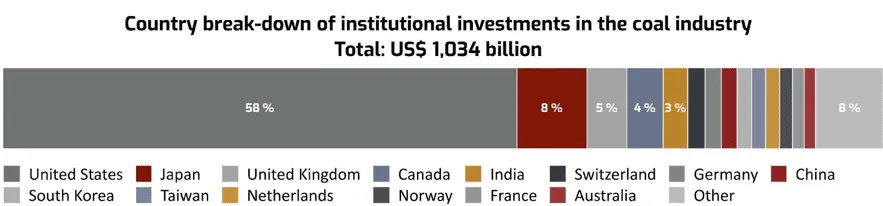
With holdings of US$ 81 billion, investors from Japan account for the second highest share of institutional investments in the coal industry. Japan’s Government Pension Investment Fund alone holds bonds and shares in value of US$ 30 billion in companies listed on the GCEL. The third largest group are UK investors, whose collective holdings in the coal industry amount to US$ 47 billion.
“While the UK government recently announced that it will end public financing for overseas fossil fuel projects in 2021, most UK institutional investors have not even begun to expel coal from their portfolios. Unless they do their homework soon, the UK-hosted COP 26 will become a big embarrassment for these institutions,” states Katrin Ganswindt.
The Biggest Lenders to the Coal Industry
Urgewald’s research identified 380 commercial banks that provided loans totaling US$ 316 billion to the coal industry over the past 2 years. The top 3 lenders are the Japanese banks Mizuho (US$ 22 billion), Sumitomo Mitsui Banking Corporation (US$ 21 billion) and Mitsubishi UFJ Financial Group (US$ 18 billion). The 4th and 5th largest lenders to the coal industry are Citigroup (US$ 14 billion) and Barclays (US$ 13 billion).
“The coal policies adopted by Japanese banks are among the weakest in the world. They only cover a small portion of banks’ lending and do not rule out corporate loans or underwriting for companies that are still building new coal plants in Japan, Vietnam, the Philippines and elsewhere. Japan’s banks must stop pouring fuel on the fire and finally adopt comprehensive coal exclusion policies,” says Eri Watanabe from 350.org Japan.
A regional breakdown of lenders from different countries shows that Japanese banks collectively provided US$ 75 billion in loans to the coal industry from October 2018 to October 2020. Commercial banks from Japanese banks alone accounted for 24% of total lending to companies on the Global Coal Exit List over the past two years. In total, Asian banks accounted for 39% of total lending.
The Biggest Underwriters of the Coal Industry
Over the same time period, 427 commercial banks channeled over US$ 810 billion to companies on the Global Coal Exit List through underwriting. The world’s top 5 underwriters are all Chinese financial institutions.
ICBC (Industrial and Commercial Bank of China), the world’s biggest bank, is the top underwriter, with almost US$ 37 billion, and also figures in the top 30 list of lenders, with US$ 3 billion. ICBC’s record on coal financing is one of the worst among the largest banks in the world, and they are involved in controversial coal projects all over the globe, such as the Sengwa power station in Zimbabwe, Hunutlu power station in Turkey, Bengkulu Coal Power in Indonesia and many more.
“Facing the prospect of a global recession, investment in coal power infrastructure will become even riskier for borrowing countries and lenders. While the world is embracing the benefits of clean and affordable renewable energy, coal projects supported will lock recipient countries into dirty, dangerous and expensive fossil fuel infrastructure that is outdated. Instead, renewable energy investments can be a major force in economic recovery, generating decent returns on investment while boosting employment opportunities. It’s time for ICBC to correctly assess the risks implicated in their investments and stop financing coal projects,” says Yossi Cadan, Global Finance Campaign Manager at 350.org.
While Chinese banks account for less than 6% of total lending to the coal industry, they account for 58% of underwriting. Through their underwriting, Chinese banks channeled US$ 467 billion to the coal industry over the past two years. Next in line are US banks (US$ 105 billion), Japanese banks (US$ 59 billion), Indian banks (US$ 36 billion) and UK banks (US$ 35 billion). Together, banks from these 5 countries account for 87% of total underwriting for the coal industry, with China, Japan and India accounting for 70%.
Commercial Banks’ Support for the Coal Industry has Increased since Paris
The research also examined the development of banks’ lending and underwriting for the coal industry since January 2016. While direct lending for coal companies spiked in 2017, subsequent years show a downward trend in lending volumes. Underwriting of coal industry shares and bonds, however, has grown steadily since 2016. The alarming result of this analysis is that commercial banks are channeling more money to the coal industry than in 2016, the year after the Paris Climate Agreement was signed.
In 2016, banks provided US$ 491 billion through lending and underwriting to companies listed on the GCEL. By 2019, this amount had grown to US$ 543 billion, an increase of over 11%.
What needs to be done?
Ending the era of coal means ending the era of coal finance and investment. But the time to accomplish this task is quickly running out.
“While coal demand is falling in the United States and Europe, coal use is growing in Asia. Japan and China have both set lofty net-zero goals and they must meet them through a managed and determined phase out of fossil fuels. Banks in Japan and China must support their countries’ climate goals by withdrawing coal investments not just within their country but also abroad as that is where the vast majority of their investments are directed. This is the only way to prevent an unmitigated climate disaster that will affect communities in Asia and globally. I write this as another typhoon bears down on the Philippines, where I live. The climate disaster is now, it is not in the net-zero future,” says Chuck Baclagon, 350 Asia Finance Campaigner.
“What we need are comprehensive, immediate coal exit policies. Insurers such as AXA, banks like Crédit Mutuel, UniCredit and Desjardins or asset managers like Ostrum have already shown what must be done by excluding most of the companies on the Global Coal Exit List from their portfolios. Now is the time for the finance industry to act. A speedy exit from coal finance and investment is not only do-able and desirable, it is a question of survival,” says Yann Louvel, policy analyst for the NGO Reclaim Finance.
###
NOTES TO EDITORS
- The Global Coal Exit List (GCEL) is a comprehensive database of companies operating along the thermal coal value chain. It is produced annually by Urgewald and can be viewed at: www.coalexit.org
- The research was carried out by Profundo, a not-for-profit research company based in the Netherlands. Profundo used several financial databases including Bloomberg, Refinitiv Eikon and IJGlobal to compile the data for this project. These databases, however, only report syndicated loans, i.e. loans, which are provided by a group of banks to an individual company. These financial databases do not report bilateral loans, where a company borrows money from only one bank, rather than from a group of lenders. A significant portion of commercial banks’ lending, namely all bilateral loans to companies featured on the GCEL, is therefore not captured by our data.
- The data also has limitations on the investor side as many pension funds and insurers do not report on their holdings. While shareholding data is generally more complete, our research probably captures less than 1/3 of the bonds institutional investors hold in coal companies. It is therefore likely that the numbers for commercial banks’ lending to the coal industry and institutional investors’ bond holdings in the coal industry are significantly higher than our research shows.
Contacts:
Jacey Bingler, Urgewald, +49 175 5217571, [email protected]
Angus Satow, Reclaim Finance, +44 7847754046, [email protected]
Nathalia Clark, 350.org, +55 61 991371229, [email protected]
Annex: Top 30 Rankings
Top 30 Lenders (Oct 2018 – Oct 2020, US$ mln)
Bank
Country
Loans
1
Mizuho Financial
Japan
22,244
2
SMBC Group
Japan
21,222
3
Mitsubishi UFJ Financial
Japan
17,929
4
Citigroup
United States
13,508
5
Barclays
United Kingdom
13,396
6
Bank of China
China
8,767
7
Bank of America
United States
8,471
8
JPMorgan Chase
United States
7,761
9
BNP Paribas
France
7,421
10
Wells Fargo
United States
6,266
11
US Bancorp
United States
5,365
12
Royal Bank of Canada
Canada
5,152
13
Commerzbank
Germany
5,061
14
Crédit Agricole
France
4,776
15
Toronto-Dominion Bank
Canada
4,418
16
Société Générale
France
4,240
17
UniCredit
Italy
4,110
18
Sumitomo Mitsui Trust
Japan
4,105
19
Credit Suisse
Switzerland
4,024
20
ING Group
Netherlands
3,882
21
Scotiabank
Canada
3,812
22
HSBC
United Kingdom
3,594
23
Santander
Spain
3,581
24
State Bank of India
India
3,566
25
PNC Financial Services
United States
3,337
26
Norinchukin Bank
Japan
3,139
27
KeyCorp
United States
3,090
28
Industrial and Commercial Bank of China
China
3,009
29
BMO Financial Group
Canada
2,977
30
Goldman Sachs
United States
2,971
TOTAL
205,191
Top 30 Underwriters (Oct 2018 – Oct 2020, US$ mln)
Bank
Country
Underwriting
1
Industrial and Commercial Bank of China
China
36,993
2
China International Trust and Investment Corp.
China
31,648
3
Shanghai Pudong Development Bank
China
27,778
4
Bank of China
China
24,263
5
China Everbright Group
China
23,764
6
Ping An Insurance Group
China
23,392
7
Agricultural Bank of China
China
22,787
8
China Construction Bank
China
22,488
9
Industrial Bank Company
China
20,931
10
China Merchants Group
China
20,780
11
Citigroup
United States
19,619
12
JPMorgan Chase
United States
18,588
13
Mitsubishi UFJ Financial
Japan
18,128
14
Mizuho Financial
Japan
17,254
15
Bank of America
United States
16,387
16
CSC Financial
China
15,686
17
Bank of Communications
China
14,907
18
Barclays
United Kingdom
14,487
19
Haitong Securities
China
14,409
20
Bank of Ningbo
China
13,787
21
China Minsheng Banking
China
13,505
22
HSBC
United Kingdom
11,597
23
SMBC Group
Japan
10,756
24
BNP Paribas
France
10,553
25
Hua Xia Bank
China
9,899
26
China Development Bank
China
9,814
27
Guotai Junan Securities
China
9,327
28
Goldman Sachs
United States
9,125
29
Morgan Stanley
United States
8,796
30
Bank of Shanghai
China
8,316
TOTAL
519,765
Top 30 Investors (2021 January or most recent filing date, US$ mln)
Investor
Country
Bonds
Shares
Total
1
Vanguard
United States
11,840
74,012
85,852
2
BlackRock
United States
4,692
79,663
84,355
3
Capital Group
United States
2,021
36,330
38,351
4
State Street
United States
1,366
31,138
32,505
5
Government Pension Investment Fund (GPIF)
Japan
3,003
26,080
29,083
6
T. Rowe Price
United States
1,099
14,337
15,436
7
Fidelity Investments
United States
3,679
11,179
14,857
8
Government Pension Fund Global
Norway
2,308
12,264
14,572
9
JPMorgan Chase
United States
2,351
11,881
14,232
10
TIAA
United States
6,877
6,952
13,829
11
National Pension Service
South Korea
7,809
3,614
11,423
12
Sumitomo Mitsui Trust
Japan
7
10,596
10,603
13
Geode Capital Holdings
United States
10,394
10,394
14
Sun Life Financial
Canada
1,655
8,735
10,391
15
State Farm
United States
4,855
4,023
8,877
16
Franklin Resources
United States
319
8,314
8,633
17
Wells Fargo
United States
537
7,832
8,368
18
Nomura
Japan
393
7,966
8,359
19
Mitsubishi UFJ Financial
Japan
88
8,164
8,253
20
Allianz
Germany
6,360
1,632
7,992
21
California Public Employees’ Retirement System (CalPERS)
United States
1,684
6,306
7,989
22
Northern Trust
United States
50
7,845
7,895
23
Prudential Financial (US)
United States
4,907
2,892
7,799
24
Invesco
United States
1,073
6,695
7,768
25
Bank of New York Mellon
United States
439
7,261
7,701
26
Wellington Management
United States
1,951
5,629
7,580
27
Berkshire Hathaway
United States
551
6,751
7,302
28
Life Insurance Corporation of India
India
7,160
7,160
29
Legal & General
United Kingdom
330
6,825
7,155
30
AFP Capital
Chile
6,866
280
7,147
TOTAL
79,110
432,749
511,859
Related press releases

As scientists confirm climate change’s role in Nepal disaster, rich nations must pay for Loss and Damage
The Energy Security We Need Is Already Here: Five Frontline Stories of Renewables in Action
